
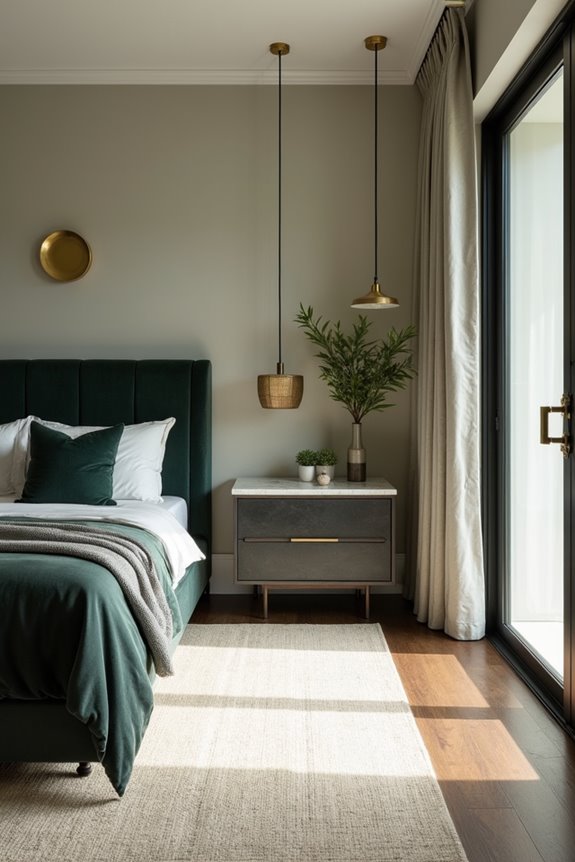
Your bedroom and bathroom don’t need identical furniture or colors—they just need intentional connection. I’d recommend choosing a shared color palette, like soft grays with sage accents, then repeating materials like brushed gold hardware or natural wood across both spaces. This creates visual harmony while letting each room serve its own purpose. You can even use opposite colors if they share the same warm or cool undertone. When you layer textures and finishes thoughtfully, you’ll create a cohesive retreat that reflects your personal style—and there’s plenty more to discover about specific design approaches that work best for your preferences.
Should Your Master Bedroom and Bathroom Match?
Why do we feel compelled to match everything in our homes, anyway? I’ve learned that your master bedroom and bathroom don’t need identical looks to feel connected. What matters is creating overall balance and space that flows naturally between the two rooms.
Master bedrooms and bathrooms don’t need identical looks to feel connected—balance and natural flow matter most.
You’ve got two solid paths forward. You can pursue cohesion by using a neutral base, repeating materials, and coordinating hardware and lighting throughout. This unified approach makes everything feel deliberate and connected.
Or you can embrace contrast. I love pairing different moods—say, a dark, warm bedroom with a bright, serene bathroom—then tying them together with shared elements like gold accents or similar undertones.
The real success happens when you choose an approach that works for you. Either route works well when you’re thoughtful about the details.
Matching vs. Coordinating: Which Approach Fits Your Style?
Here’s the detail about decorating—you don’t have to choose between making your spaces feel connected or letting them breathe as their own thing. I’ve found that coordinating works better than strict matching for most people. You’re creating a connected flow without forcing identical furniture or fixtures into both rooms.
Think of it this way: use a shared color palette, consistent hardware finishes, and similar design language. Maybe your bedroom features soft blues with brass fixtures, while your bathroom echoes those blues but adds spa-like elements. This approach gives you flexibility. Each space serves its own purpose while still feeling like it belongs to the same home.
Matching feels rigid and limiting. Coordinating? That’s where your personality comes through, creating harmony without sacrificing function.
How Color Palettes Create Visual Harmony
Once you’ve decided to coordinate your bedroom and bathroom, color becomes your most powerful tool for tying them together. I recommend starting with a neutral base—soft grays, warm whites, or gentle beiges on walls and floors. This creates stability across both spaces.
Then choose analogous colors, those living happily next to each other on the color wheel. If you pick soft blue for your bedroom, introduce blue-green or blue-purple accents in your bathroom through towels, hardware, and decor. This approach builds cohesion without feeling matchy-matchy.
The result comes when you repeat supporting hues intentionally. A sage green throw pillow in your bedroom pairs beautifully with sage-tinted bathroom accessories. You’re creating visual flow that whispers rather than shouts, inviting calm throughout your personal retreat.
Layer Shared Materials and Textures for Subtle Continuity
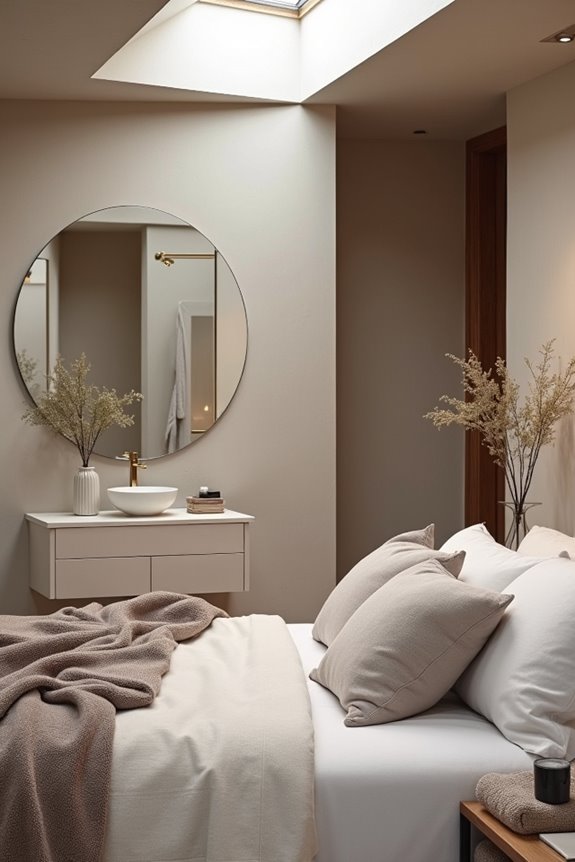
I’ve found that repeating materials like brushed nickel hardware, natural wood shelving, and stone tiles across both rooms creates continuity that appears deliberate rather than repetitive. You can layer in textures—think soft linen hand towels in your bedroom that echo the linen shower curtain in your bathroom, or woven baskets that ground both spaces with warmth and tactile interest. These finishing details, when chosen with care, tie your personal spaces together in a way that works and feels cohesive.
Material Repetition Across Spaces
What if your bedroom and bathroom could feel intentionally connected, even though they serve completely different purposes? You can create that through material repetition and textures.
Using the same tile style in both rooms creates a visual link between the spaces. Perhaps you choose marble for your bathroom vanity, then repeat it with marble accents on bedroom shelves. The same wood finish on furniture works well too.
The key is repetition that doesn’t feel forced. Match your metal hardware finishes across both spaces. Use linen textures in both rooms, or apply matte black surfaces consistently. Even painting with the same sheen—eggshell or satin—connects everything together.
This approach lets each room maintain its own character while feeling part of one unified home. That’s the connection you’re building.
Texture Layering Techniques
How do you connect two rooms without making them look identical? Layering textures creates visual connection while keeping each space distinct.
Consider these texture-layering approaches:
- Incorporate woven textiles like jute runners or linen curtains in both rooms
- Add shag or wool rugs that echo across spaces with different colors
- Use natural materials such as wood frames, stone accessories, or ceramic tile accents
- Layer fabric textures through throw pillows, blankets, and upholstered pieces
- Mix smooth and tactile elements for depth and interest
When I repeated linen drapes and woven wall hangings between my bedroom and bathroom, the spaces felt connected while maintaining their own personality. The textures created a visual relationship across the doorway, building harmony without appearing identical. Each room works as part of a larger whole while standing on its own.
Finishing Touches For Cohesion
The path to bedroom and bathroom harmony lies in the materials and textures you repeat across both spaces. Thoughtfully layering shared elements creates a connected home that demonstrates planning and care.
| Element | Bedroom | Bathroom |
|---|---|---|
| Wood Tones | Walnut nightstands | Walnut vanity |
| Hardware Finishes | Brushed gold pulls | Brushed gold fixtures |
| Textiles | Linen bedding | Linen hand towels |
| Patterns | Geometric throw pillows | Geometric shower curtain |
| Accent Materials | Marble side table | Marble countertop |
Your wood tones anchor the connection well. Matching brushed gold or matte black hardware finishes across drawer pulls, faucets, and light fixtures creates visual flow without feeling predictable. Layer the same woven textiles—linen sheets paired with matching bath linens—to establish comfort throughout. These subtle repetitions tell a cohesive story, making both spaces feel thoughtfully designed rather than randomly decorated.
Hardware and Lighting: The Unspoken Design Links
While you might not realize it, the fixtures you choose for doorknobs, faucets, and light switches are quietly doing some of the heaviest lifting in your home’s design. These elements create invisible threads connecting your bedroom and bathroom into one cohesive space.
The fixtures you choose—doorknobs, faucets, light switches—quietly create invisible threads connecting your entire home into one cohesive space.
Here’s how hardware and lighting work together:
- Repeating metal finishes like brass or matte black across both rooms reinforces unity
- Coordinating lighting tones—warm or cool white—establishes consistent mood throughout
- Matching sconces or recessed ceiling lights echo architectural rhythm
- Cabinet pulls and faucet styles create deliberate design language
- Complementary hardware tells a story of deliberate choices
When you align these often-overlooked details, you’re not just decorating. You’re creating a space where everything feels purposeful and connected. That’s what thoughtful design accomplishes.
Modern Coastal: Light Blues and Sandy Neutrals
I’m excited about modern coastal design because it brings your bedroom and bathroom into visual harmony through a straightforward color approach. You’ll want to anchor your rooms with sandy neutrals like beige, tan, and warm cream, then layer in crisp whites for brightness and light blues—think soft seafoam or pale aqua—that evoke that breezy, sunlit feeling without overwhelming the space. This combination works well whether your bedroom and bathroom connect visually or sit separately, creating unity through a shared palette that feels thoughtful and restful.
Coastal Color Palette Essentials
How do you create a bedroom and bathroom that feel like a peaceful beach escape without overwhelming the space with color?
A coastal color palette creates bathroom harmony and bedroom unity through restraint. You don’t need bold hues—instead, embrace soft, calming tones that work beautifully in both rooms.
Here’s what I recommend:
- Soft blue walls (think pale seafoam or gentle sky blue) as your foundation
- Sandy beige or ivory accents for warmth and contrast
- Driftwood tones in furniture or trim for natural texture
- Crisp white elements to keep everything fresh and airy
- Subtle variation rather than saturated, competing colors
This coastal color palette creates cohesion between spaces. Using these same soft blues and sandy neutrals in both rooms makes moving between them feel seamless. The result is a calming home that feels connected, welcoming, and coastal without feeling cluttered or overwhelming.
Sandy Neutrals With Crisp Whites
When you bring sandy neutrals and crisp whites together, you’re creating the foundation for a modern coastal style that feels both sophisticated and relaxing. Soft gray walls paired with white bathroom fixtures create a serene backdrop that doesn’t feel stark or cold. The contrast matters. White cabinetry, trim, and tile work beautifully against warm beige and pale taupe elements, keeping everything feeling fresh and clean. These neutral tones provide breathing room in your spaces. By layering sandy hues with crisp whites, you’re establishing visual balance that works well together and invites you in. This combination gives you flexibility too—you can introduce soft textures and natural materials without overwhelming the peaceful palette you’ve built together.
Minimalist Luxe: Clean Lines and Unified Elegance
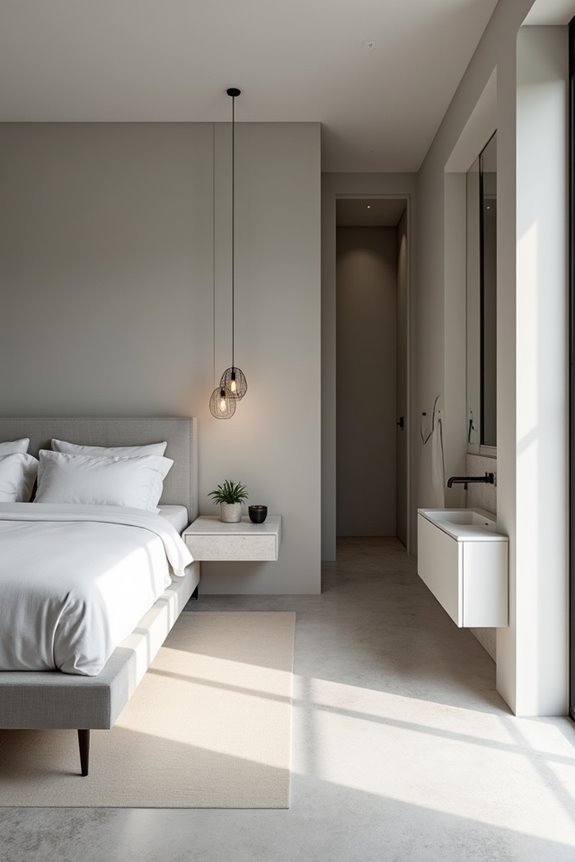
Why settle for spaces that feel disconnected when you can create a bedroom and bathroom suite that expresses sophistication through intentional simplicity?
Minimalist Luxe achieves unified elegance through restraint. I use neutral tones—whites, grays, taupes—across both rooms, creating visual harmony that works rather than feels accidental. Consistency comes when you repeat materials strategically.
Consider these elements:
- Marble countertops and coordinating tile accents
- Brushed metal hardware on vanities and bedroom furniture
- Glass shelving in matching finishes
- Streamlined lighting fixtures with dimmable capabilities
- Purposeful decor that serves a function
Each piece connects the spaces visually. My streamlined approach eliminates clutter, allowing each room to breathe while maintaining mood consistency. This careful restraint creates a calm sanctuary where every detail reinforces sophistication. You’re not just decorating—you’re crafting belonging through deliberate design choices.
Rustic Retreat: Earthy Tones and Shared Warmth
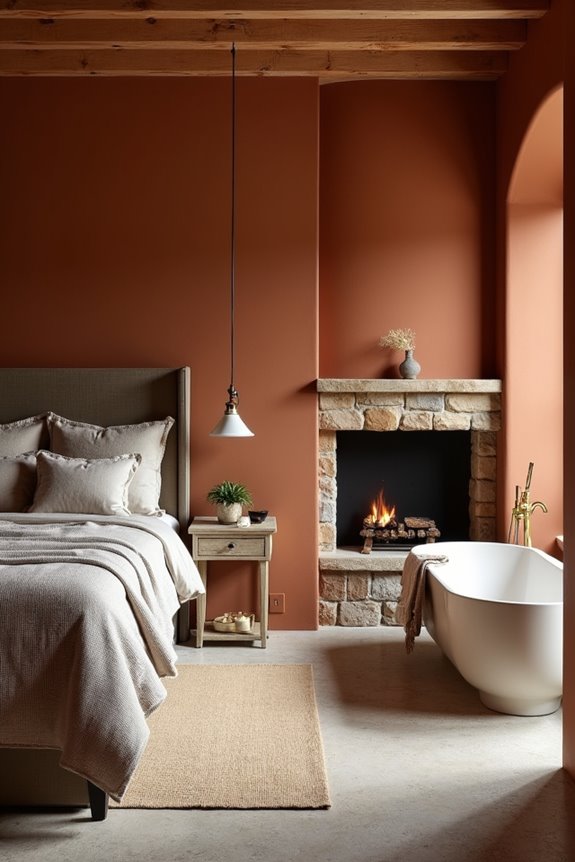
When you bring reclaimed wood beams, barn doors, or weathered shelving into both rooms, you’re creating a genuine connection that speaks to authenticity and warmth. I love how matte black hardware—think cabinet pulls, towel bars, and light fixtures in that deep finish—grounds the natural wood tones without competing with those beautiful earthy textures. This coordinated approach brings your bedroom and bathroom together as spaces that were designed with purpose, rather than two separate rooms that simply exist in the same home.
Reclaimed Wood Elements
How’s this for tying your bedroom and bathroom together? Reclaimed wood creates instant harmony between these spaces. I love how weathered beams and salvaged planks bring authentic warmth to both rooms.
Here’s what makes reclaimed wood work well:
- Adds natural texture that feels grounded and inviting
- Pairs perfectly with matte black hardware for striking contrast
- Combines with neutral fabrics like cream and taupe for cohesion
- Requires moisture-resistant sealants in bathrooms to prevent warping
- Balances with lighter elements to avoid feeling heavy
The key is protecting your investment. In bathrooms especially, I apply quality sealants that shield wood from water damage while maintaining that gorgeous rustic character. Pairing these elements with white walls and light textiles keeps everything feeling fresh. When you carry reclaimed wood through both rooms thoughtfully, you’re creating a retreat that feels genuinely yours—a space where you truly belong.
Matte Black Hardware Coordination
Now that you’ve anchored your rustic retreat with reclaimed wood, matte black hardware becomes your tool for pulling everything together. I’ve found that coordinating matte black fixtures—handles, hinges, faucets—creates a unifying visual thread between your bedroom and bathroom. This finish contrasts beautifully against warm browns, greens, and terracotta walls, enhancing depth and highlighting architectural features you’ve worked to showcase. When you use matte black consistently across both spaces, you’re creating deliberate coordination that feels thoughtful, not accidental. The trick? Balance this bold hardware with soft linens and natural textures so your rooms stay warm and inviting. You’re not going for stark or industrial. Instead, you’re building spaces where every detail belongs, where visitors feel the care you’ve invested in making your home cohesive.
Organic Modern: Natural Elements That Connect Spaces
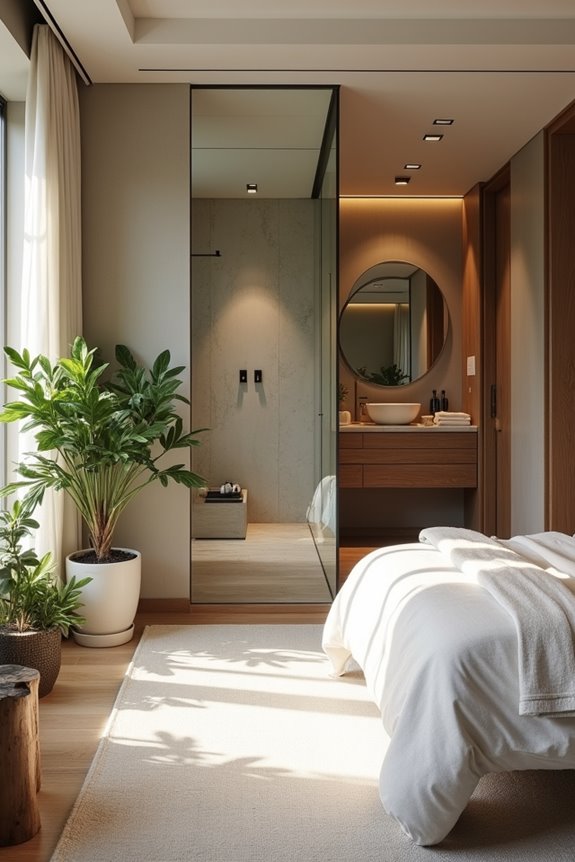
Why settle for a bedroom and bathroom that feel like separate worlds? Organic modern design creates cohesion between these intimate spaces through natural elements that speak to each other.
Organic modern design unifies bedroom and bathroom through natural elements that create purposeful, cohesive spaces.
When I layer warm woods, soft neutrals, and authentic textures throughout both rooms, the spaces feel connected and purposeful. My suite works as one unified environment rather than disconnected rooms.
Here’s what builds continuity in a primary suite:
- Light wood cabinetry paired with creams and warm grays
- Round mirrors and pebble trays that echo organic shapes
- Matte stone countertops mirroring bedroom accent walls
- Low-maintenance plants bringing life to both spaces
- Natural fiber textiles creating consistent, breathable warmth
The practical benefit? I’m not copying finishes exactly. Instead, I’m creating a language of materials—leather, linen, sustainable wood—that flows naturally between rooms. This approach honors each room’s function while building the continuity that makes a primary suite work as a cohesive environment.
Scandinavian Calm: Simplicity as a Unifying Thread
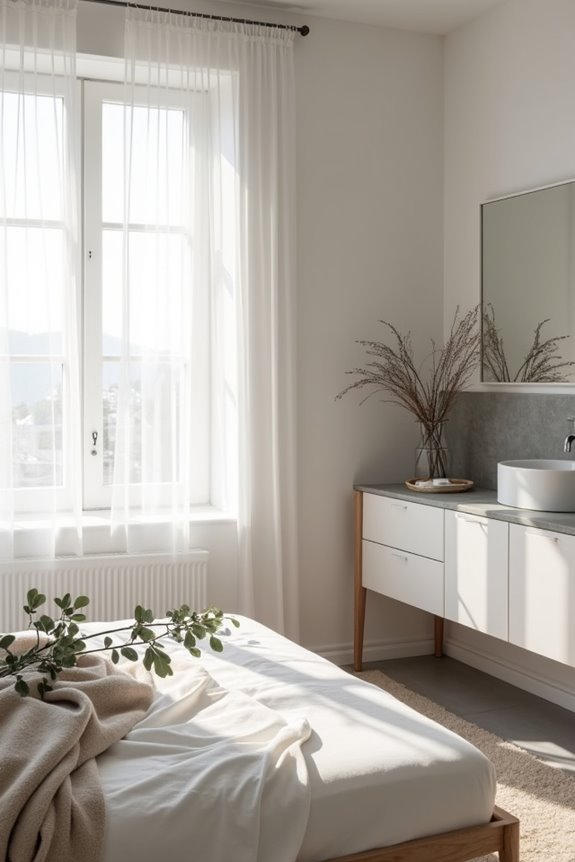
While organic modern design connects spaces through layered natural materials, Scandinavian calm takes a different path—it strips everything back to basics and builds cohesion through restraint. This approach creates harmony without overwhelming your senses.
You’ll achieve this by using whites, grays, and pale wood tones consistently across both rooms. Keep lines clean. Choose functional pieces over decorative ones. Natural materials like light timber, linen textiles, and subtle wool accents provide texture without clutter.
Lighting plays a key role—soft, diffuse illumination paired with strategic task lighting maintains that peaceful atmosphere. Carry the same understated hardware throughout. Allow each room’s purpose to guide specific details while the calm color palette ties everything together.
When and How to Differentiate Your Bedroom and Bathroom
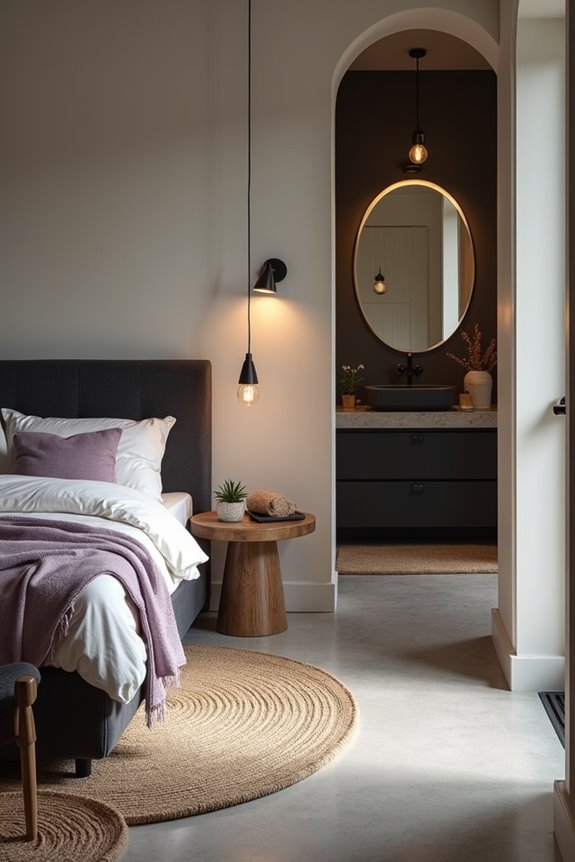
Just because your spaces share a design foundation doesn’t mean they need to feel identical—in fact, they shouldn’t.
Two spaces can honor cohesion while still celebrating their unique purposes. Here’s how you can differentiate without losing harmony:
- Use contrasting color palettes that share undertones (warm bedroom, cool spa-like bathroom)
- Layer warm, ambient lighting in your bedroom; install bright, task-focused lights above your vanity
- Choose textiles and art for your bedroom, then swap in towels and bath accessories for your bathroom
- Keep hardware finishes consistent across both rooms for visual connection
- Add personal touches like bedroom plants alongside bathroom bath salts
Your bedroom whispers comfort. Your bathroom speaks cleanliness. Together, they tell your story while maintaining that sense of belonging throughout your home.
Create Contrast Without Discord: Opposite Colors on the Same Undertone
I’ve discovered that undertone unity—keeping warm or cool tones consistent across both spaces—lets you use opposite colors without creating that unsettling clash you might worry about. Think of pairing warm beige walls in your bedroom with deeper taupe in your bathroom; both share that warm foundation, so they read as coordinated rather than mismatched. By anchoring both rooms with coordinated elements like brushed gold fixtures or matching wood tones, you’ll build visual interest that strengthens your home’s overall harmony instead of fragmenting it.
Understanding Undertone Unity
How do you create a bathroom and bedroom that feel beautifully distinct yet harmoniously connected? Undertone unity accomplishes this by matching warm or cool undertones across both spaces, creating cohesion without boring sameness.
Here’s what makes undertone unity work:
- Warm undertones (oranges, creams, golds) naturally complement each other across rooms
- Cool undertones (blues, silvers, purples) maintain harmony while allowing distinct identities
- Opposite hues on the same undertone spectrum prevent visual clash
- Value variations within shared undertones create depth and interest
- Repeated textures like warm wood or brass hardware reinforce connection
When warm peachy tones connect the bedroom and bathroom, they feel like they belong together. The spaces have their own character yet speak the same visual language. That’s undertone unity—creating rooms that read as thoughtfully designed rather than accidentally mismatched.
Opposite Colors, Shared Foundation
What if your bedroom and bathroom could feel visually connected yet distinctly different—without clashing?
Opposite colors work well when they share the same undertone. Think warm taupe walls in your bedroom paired with cool taupe accents in your bathroom. They’re opposites, but they speak the same language underneath.
This shared foundation keeps your spaces feeling deliberately designed, not accidentally mismatched. You’re creating contrast without discord. Apply these opposite hues strategically—walls in one room, accents in another—to preserve each space’s mood and function.
Ground stronger colors with neutral surfaces like white or beige. Test paint swatches in both rooms under similar lighting. This maintains consistent undertone while your colors appear distinctly different. The result? Connected spaces that reflect your taste.
Balancing Visual Interest Effectively
Creating visual interest in connected spaces doesn’t mean you’ve got to choose between harmony and excitement. I’ve discovered that you can introduce opposite colors while keeping everything feeling cohesive—it’s all about strategy and smart choices.
Here’s how I balance contrast without creating discord:
- Use the same undertone family: Pair warm peach with cool taupe for sophisticated depth
- Control dosing: Apply stronger colors as accents, not dominant walls
- Keep shared elements consistent: Match hardware finishes and textile undertones across both rooms
- Choose near-adjacent shades: Adjacent colors feel natural together, even when opposite
- Create a focal point: Feature one statement element rather than overwhelming the space
When you’re thoughtful about undertones and restraint, your bedroom and bathroom feel intentionally connected yet individually interesting. That’s the sweet spot where you’ll feel genuinely proud of your space.
The Spa Bathroom and Cozy Bedroom: Balancing Function With Mood
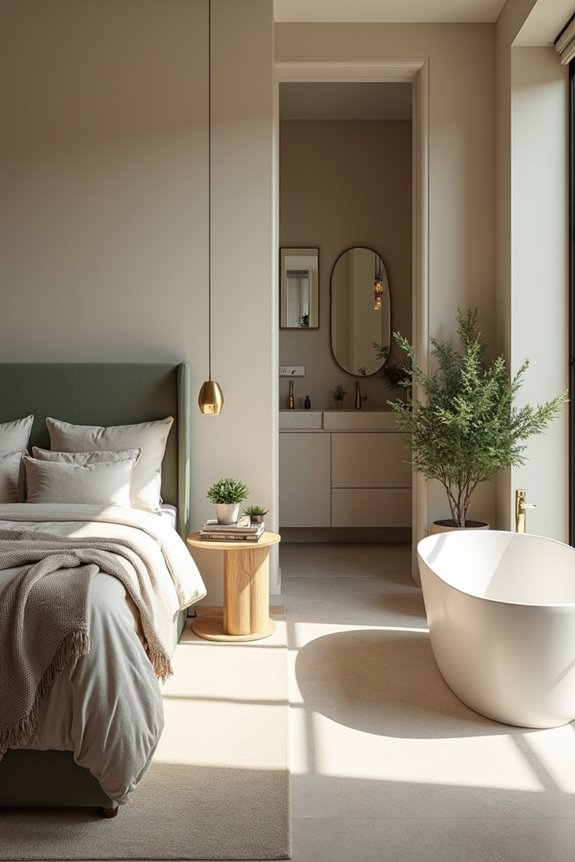
Why shouldn’t your spa bathroom and cozy bedroom feel like they belong together, even if they’re decorated differently?
Creating harmonious spaces doesn’t require matching everything—use shared elements like soft neutrals and warm lighting to build cohesion.
I find that creating harmonious spaces doesn’t require matching everything perfectly. Instead, I use shared elements to build cohesion: soft neutrals, natural wood, and warm lighting connect both rooms beautifully. The bathroom stays bright and serene for its functional purpose, while my bedroom becomes warmer and more intimate—each space serves its own needs.
I repeat small details like brass hardware or matte black fixtures throughout both rooms. This subtle threading creates visual unity without making either space feel repetitive. Analogous colors and complementary accents work wonderfully together, letting each room maintain its distinct personality while feeling connected.
The result? Two spaces that calm my soul and feel like home.
Use Gold Finishes to Bridge Your Spaces
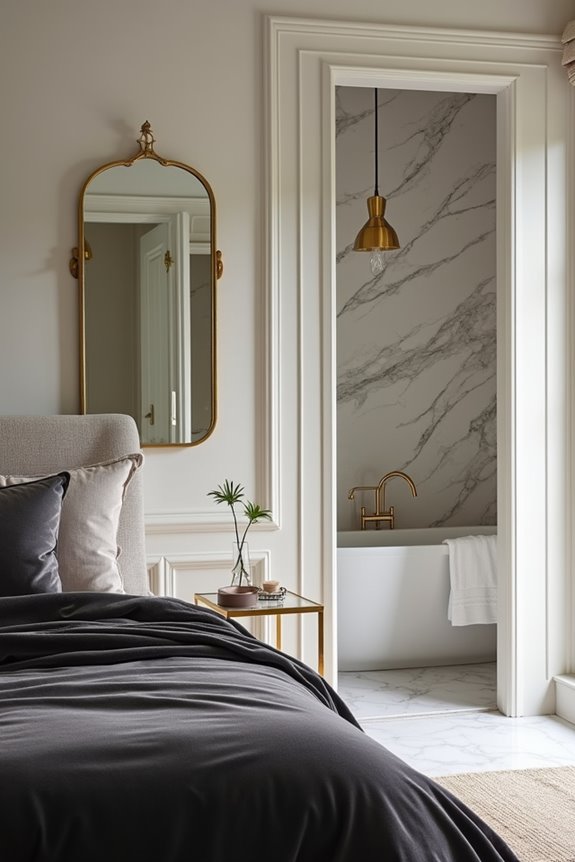
How do you connect two rooms that serve completely different purposes? I’ve found that gold finishes create a unifying thread between your bedroom and bathroom, bringing cohesion without matching everything.
Gold hardware works well because it has warm undertones that complement wood furniture and creamy neutrals. When I repeat gold elements intentionally, the spaces feel connected rather than coincidental.
Here’s what I focus on:
- Mirror frames with gold accents
- Faucets and drawer pulls in brushed or polished gold
- Light fixtures that echo the same metallic tone
- Picture frames and wall décor
- Cabinet hardware that matches throughout
I balance bold gold with softer whites and grays so the look doesn’t feel overwhelming. This approach lets each room maintain its own personality while belonging to the same home.
Design Your Master Suite: Balance Coordination With Personal Vision
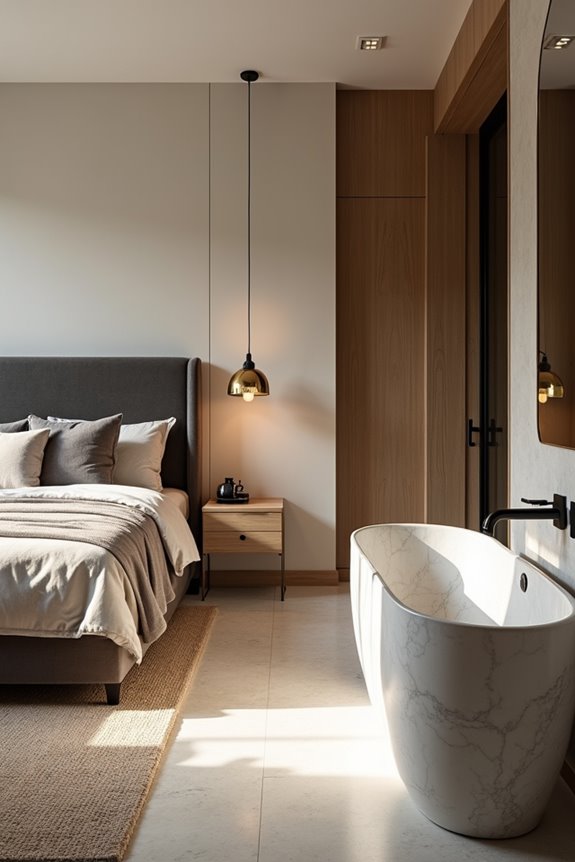
When you’re pulling your bedroom and bathroom together, consider them as two parts of one personal retreat rather than separate rooms. You don’t need matching everything. Instead, choose a shared color palette—maybe soft grays with sage accents—and repeat it through both spaces. Using the same hardware finishes on your vanity and bedroom nightstands creates visual connection without feeling forced.
The key is letting each room function independently while staying visually linked. Your bathroom can be more functional, your bedroom more relaxed. When you echo textures, materials, or accent colors between them, you’re building a sanctuary that feels designed with intention. That’s when a master suite becomes distinctly yours.